Skip to content
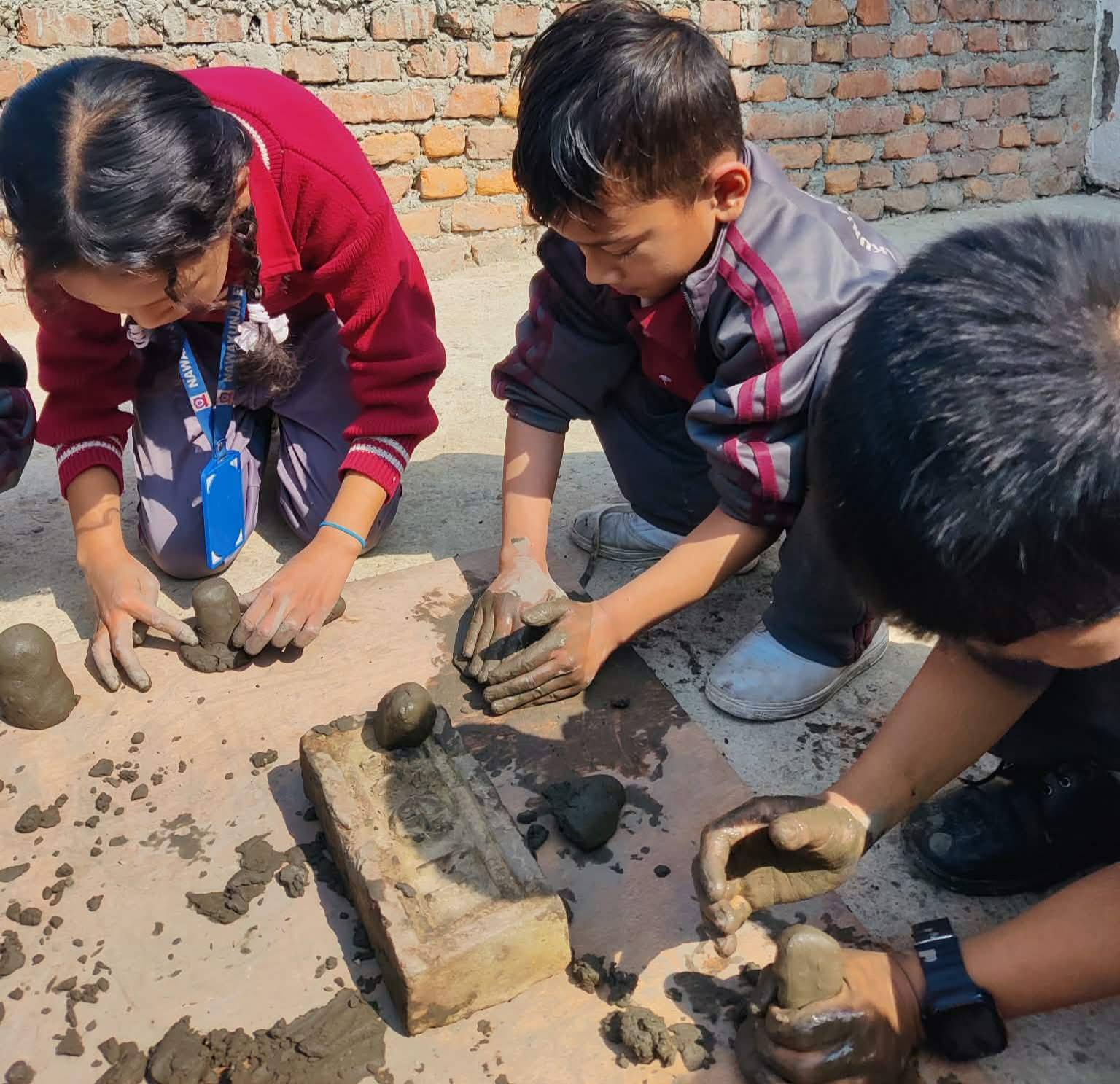
Nawakunja students working with clay — hands-on activity-based learning

Programs

From Nursery to Secondary — one child-first thread.

Grade-wise programs aligned with Government of Nepal CDC guidelines. Portfolio-based continuous assessment for lower grades — no high-stakes exams until it truly matters.

How the years connect

One school. Five stages. The same care.

Every level keeps the same commitments — play, inquiry, inclusion, care — and builds on the last.

  1. Play · Story · Song

    Early Years

    Nursery · LKG · UKG · age 3 to 5 years

    Enquire

    A gentle, joyful start. Children build confidence, language, and motor skills through play, stories, songs, and guided exploration — never through tests.

    Focus areas

    • Listening, speaking, early reading in English and Nepali
    • Numbers, shapes, sorting, patterns — through manipulatives
    • Fine and gross motor development
    • Social-emotional habits: turn-taking, kindness, curiosity
    • Creative expression: art, music, movement
  2. Integrated · Theme-based

    Integrated Basic (Grades 1–3)

    Grades 1 · 2 · 3 · age 6 to 8 years

    Enquire

    Following Nepal's Integrated Curriculum (सामुदायिक/एकीकृत पाठ्यक्रम). Subjects are woven into themes — community, water, seasons, health — so learning feels whole.

    Focus areas

    • Reading fluency and writing confidence (English + Nepali)
    • Number sense and hands-on math
    • Inquiry-based environmental studies
    • Art, music, physical education, values education
    • Design-thinking mini-projects — build, test, share
  3. Transition · No exams

    Transition Grade

    Grade 4 · age 9 years

    Enquire

    Grade 4 is our gentle bridge into subject-wise learning. Children still experience continuous assessment — no formal exams — while gaining stronger study habits.

    Focus areas

    • Stronger academic reading and writing
    • Deeper math reasoning and early pre-algebra sense
    • Science investigations with simple experiments
    • Social studies, Nepali, English, computer literacy
  4. 7E · Design thinking

    Basic Upper (Grades 5–8)

    Grades 5 · 6 · 7 · 8 · age 10 to 13 years

    Enquire

    Here the 7E model comes fully into play: Elicit, Engage, Explore, Explain, Elaborate, Evaluate, Extend. Students take greater ownership of their learning.

    Focus areas

    • English, Nepali, Math, Science, Social Studies
    • Health, Physical Education, Computer Science
    • Optional: Moral/Values education, Arts, Music
    • Independent projects and research skills
    • Public speaking, presentations, peer teaching
  5. SEE · Life-ready

    Secondary (Grades 9–10)

    Grades 9 · 10 · age 14 to 15 years

    Enquire

    Preparation for the Secondary Education Examination (SEE) while keeping our child-centered, design-thinking approach alive. We prepare humans, not just candidates.

    Focus areas

    • Compulsory: English, Nepali, Math, Science, Social Studies
    • Optional subjects (as per CDC): Computer Science, Accounts, etc.
    • Strong focus on concept clarity, writing, and practical skills
    • Career exposure, study skills, stress-management support

Not sure which program fits?

Let's figure it out together.

A 20-minute conversation is better than any brochure. Drop by the campus, or call us — we'll walk you through the right year for your child.