1
Child-centered, design-thinking pedagogy
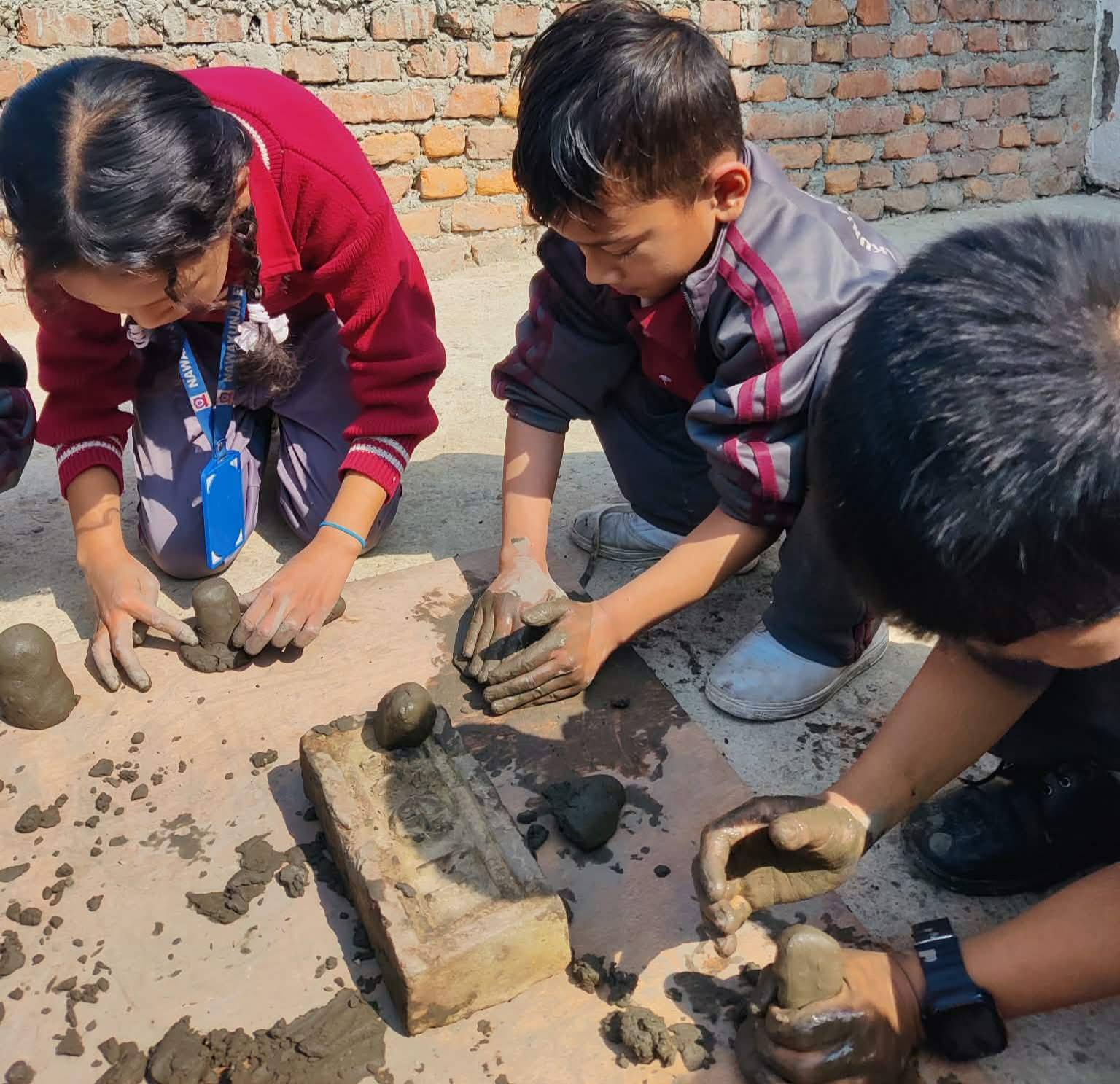
Empathise → define → ideate → prototype → test. Classrooms that treat children as thinkers, makers, and problem-solvers.
Academics
A child-centered, design-thinking, transdisciplinary curriculum — delivered through the 5E and 7E learning models.
Our teaching principles
Not buzzwords — daily practice, visible in every classroom.
Empathise → define → ideate → prototype → test. Classrooms that treat children as thinkers, makers, and problem-solvers.
A school-developed syllabus that weaves literacy, numeracy, science, art, and values into one meaningful story rather than disconnected subjects.
Learning organised around real themes children can see, touch, and talk about — seasons, water, community, health.
Intentional daily practice in listening, speaking, reading, and writing — in English and Nepali — so every child becomes a confident communicator.
We welcome diverse learners, including those with different learning needs. Teachers adapt tasks, not standards.
ICT-based teaching, smart-class resources, and safe, purposeful screen use that supports (not replaces) hands-on learning.
Children are encouraged to ask "why" and "what if" — to build, test, revise, and share ideas.
The 5E cycle
The 7E extension
Aligned with Govt. of Nepal CDC
We follow the Government of Nepal's direction for early grades: learning comes first, exams don't. Children in grades 1–4 are assessed continuously — through observation, portfolios, presentations, and projects — not through high-stakes tests.
In the smart classroom
Nawakunja students research real places, prepare their own slides, and present on the smart board — in English and Nepali. A sample of recent student projects:
Secondary · Social Studies
A student-led presentation on Kalinchok Bhagwati's origin story, its sacred geography, and the mountain ecology that surrounds it — combining religious studies, geography, and storytelling.
Secondary · Social Studies
Exploring Dolakha Bhimeshwor temple as a living cultural and ecological site — pilgrims, architecture, and the surrounding hill system.
Secondary · Integrated
Students analyse why remote localities like Sailung face economic pressures — land use, migration, tourism, and what sustainability could look like locally.
Upper Basic · EVS / English
Comparing food, housing, health, and daily life between rural and urban settings — a core Grade-6-ish theme brought alive through research and presentation.
Secondary · Project
A field-inspired study of Tharu traditional housing, ~42 medicinal plants, and the famous stick-dance — connected to design-thinking questions about sustainable community design.
Every child presents. Speaking, researching, building slides, and handling Q&A are core habits we grow from the earliest years — gently in lower grades, with real depth by Secondary.
Frequently asked
No. In line with Government of Nepal Curriculum Development Centre guidance for the Integrated Curriculum, early grades use continuous assessment — portfolios, observation, and projects — rather than high-stakes written exams. Children build confidence and love of learning first.
English is the primary medium, alongside structured Nepali language development. Young children hear, speak, read, and write English across the day in a supportive, immersive environment.
A child-centered, design-thinking approach delivered through an integrated, transdisciplinary curriculum. Lessons use the 5E cycle (Engagement, Exploration, Explanation, Elaboration, Evaluation) and, for deeper inquiry, the 7E extension (adding Elicit and Extend).
Yes. Nawakunja is committed to inclusive education. We welcome diverse learners and adapt tasks and supports so every child can progress meaningfully.
Mahalaxmi-6, Siddhipur, Lalitpur. Visitors are welcome — please call 9849034724 or 01-5709124 to arrange a tour.
Start with a campus visit. After an informal interaction with the child and submission of documents (birth certificate, transfer if any, parent ID, photos), we confirm the seat and send the admission letter.